
About BOYA and its concept
Passionate about flowers, Yan MAO founded BOYA in 2018. It was a life change after working for seven years in a large international cosmetics group.
For Yan, BOYA is a meeting place for people who share the same passion, the same sensibilities, and the same desire to share them. With BOYA, she intends to create a new experience in floristry, a place that awakens all the senses, that invites you to linger and relax.
Like her, BOYA's customers don't consider a bouquet an unnecessary luxury, but an essential element of our daily lives.
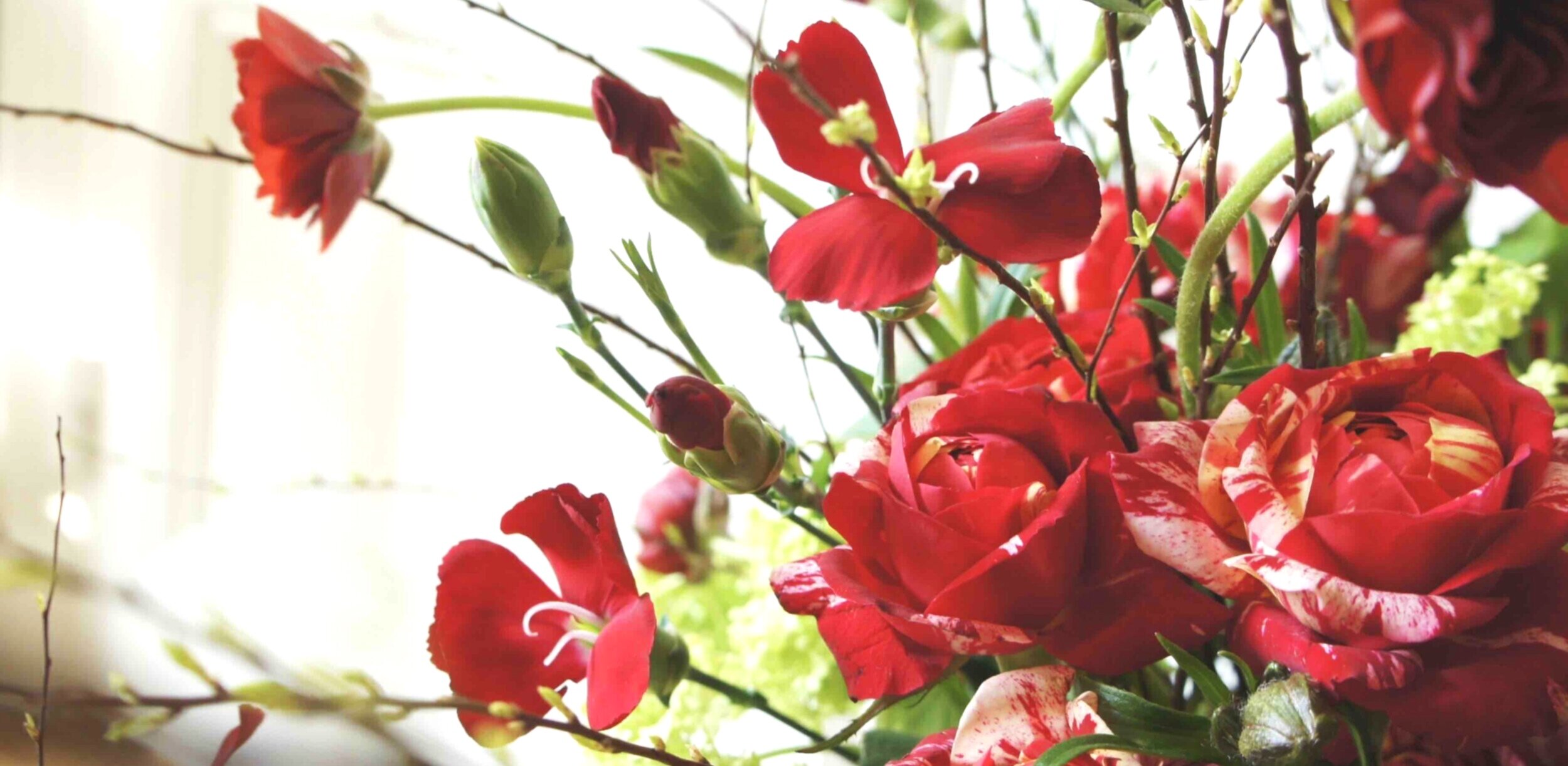
Fleurs rouges rose oeillet renoncule bouquet coloré joyeux
A floral art shaped by the meeting of two cultures
IIntroduced to floral art in France in 2008, but inevitably influenced by her Chinese heritage, Yan brings a unique perspective to the world of plants and leaves a distinctive mark of both cultures in her creations.
In her arrangements, she doesn't force plants into a predetermined shape or frame. On the contrary, she adapts to ensure that the attitude and movement of each flower are respected, as if they were found in nature. She seeks to create "perfectly imperfect" bouquets, bouquets with movement and soul.
For Yan, arranging a bouquet is simultaneously an art, a stylistic experiment, an enchanting pastime, and an excellent form of relaxation therapy. It's like painting with a living material.
In our fast-paced world, here's a way to reconnect with nature: choosing flowers, touching them, smelling them—a wonderful way to rediscover your own rhythm, master time, and create your own living space!
OUR vision


Flowers & Home
Chinese floral art seeks to bring nature into the home, because humans, being part of nature, must coexist harmoniously with it. Thus, the most successful floral arrangements are those that best "imitate" nature. In contrast, in the West, flowers are considered a decorative element in the home, just like wallpaper, objects, and furniture.
Both approaches share a common thread: in a home, flowers must be in perfect harmony with the setting, with the overall decor of the room, and with the furniture and objects that surround them.
A harmonious bouquet will enliven a room; it will be there to welcome your friends and brighten your moments of solitude. Like us, you surely feel the "emptiness" that the absence of flowers so often creates in a house or apartment, and you realize how much they can beautify a home and make its atmosphere more pleasant.
That's why at BOYA, we don't consider a bouquet outside of its context. When we design a bouquet, we look beyond each individual flower, but at the balance, the lines, and the overall compatibility with the place where it will be placed.
Our tips for adding flowers to your home »


Flowers & Vases
In China, the art of choosing a vase is as important as the art of arranging flowers. It's impossible to judge a floral arrangement without its vase, and impossible to arrange flowers without having chosen the right vase. This is why Chinese floral art is called "Ping Hua." "Ping" means vase, and "Hua" means flowers.
The choice of vases—material, size, shape—is determined by the flowers, the season, the location, and the room's decor. Vases have the power to transform flowers: they alter their colors and texture. The same bouquet in different vases will always look new.
At BOYA, we place particular importance on vases. Not only are our flowers presented in beautiful vases that enhance them, but a multitude of vases are also offered for sale: antique vases, handcrafted vases, European or Asian designer vases, glass vases, ceramic vases, metal vases, bamboo vases, paper vases… No BOYA bouquet is designed without the container being considered.

About BOYA
BOYA is the name of the pagoda built approximately one hundred years ago on the campus of Peking University. Founded in 1898, the campus was once an imperial garden. It has perfectly preserved its landscaped garden characteristics, with numerous lakes and hills. The entire grounds remain lush and blooming throughout the seasons.
This place held a special place in Yan Mao's childhood, where she spent time picking flowers, and also in her youth, where she studied for four years.
The BOYA Pagoda is therefore much more than a monument for Yan. It symbolizes the place where her love for nature and flowers was born, a love that would later become her vocation.